
A Cross‑Border Journey of an Energy Storage Cabinet: From Guangdong to
An energy storage cabinet sets off from Guangdong and arrives at a Thai customer’s warehouse. How many days does it take in total? Production takes about two weeks, sea freight over thirty days, and when you add up the earlier stages—communication, design, certification, sampling, production scheduling—the whole process comes to nearly three hundred days.
During those three hundred days, the customer cannot see what is happening in the factory; they can only occasionally receive an email saying “in production,” “shipped,” or “estimated arrival at port.” For the customer, these three hundred days are a black box.
So with this article, we want to open that black box. Taking a real order shipped to Thailand as an example, we will tell you exactly what Longvictor New Electrical Technology did during those three hundred days. This is not a simple log, but rather the logic behind each step.
Days 1 to 30: Requirement Communication – Turning “What Is Wanted” into “What Can Be Done”
The first email the customer sent was not an order, but a list of requirements. It specified how many units they needed, the environment they would be placed in, how many batteries to include, what type of inverter to use, what color the casing should be, whether a Wi‑Fi module was needed, and so on.
These seemed straightforward, but the real challenge lay in what was not written. For instance, when the customer said “to be installed outdoors,” we had to follow up: what is the lowest temperature in winter? What is the highest in summer? Is there a risk of typhoons? Is waterproofing required? Should heating pads be added?
We asked these questions not to complicate things, but because the design of an energy storage cabinet varies significantly depending on the environment. In places where temperatures drop to minus twenty degrees, batteries need heating to function properly. In humid coastal areas, the level of corrosion protection must be increased. In locations with frequent power outages, the switching speed needs to be faster.
At first, the customer thought we were asking too many questions. But later they understood: the more detailed these inquiries are, the lower the likelihood of problems down the line. This communication phase took us nearly a month. Over thirty emails were exchanged before the technical solution was finally finalized.
Days 31 to 60: Certification Preparation – Securing the Product’s “Visa” for Export
For an energy storage cabinet to be exported to Europe, it cannot simply be packed and shipped. It requires a host of certifications: CE certification, IEC standards, EMC testing, RoHS reports… Each one takes time and money.
For this order, the customer requested a full set of European certifications. This meant we had to send a prototype to a third‑party laboratory for various tests—electromagnetic compatibility tests, safety tests, environmental tests—each with its own queue, waiting period, and report issuance.
The most challenging part was that sometimes a test would fail, requiring us to go back and modify the design before retesting. For one of our products, the EMC test was conducted three times before it passed. The first time, the power supply filtering was inadequate; the second time, there was an issue with the grounding method; only on the third attempt did it pass all requirements.
The customer asked us why certification took so much time. We explained that these certifications serve as your customs clearance documentation and also act as your permit to sell to end users. Without them, the cabinets would not even be able to enter the country.
Days 61 to 90: Sample Confirmation – Turning Drawings into Physical Products
After the certifications were approved, we began sample production. The purpose of making a sample was to allow the customer to see and touch the actual product with their own eyes, confirming that “this is exactly what I want.”
Once the prototype was ready, we took photos and videos and sent them over. After reviewing them, the customer said there was a slight color difference between the casing and the drawings. We adjusted the formula, resprayed a unit, and sent new photos. The customer then asked whether the angle of the display screen could be adjusted to make installation easier for them. We modified the bracket design again and produced another unit.
With three rounds of revisions back and forth like this, the customer finally said “it’s acceptable.” From the first prototype to final confirmation, nearly another month had passed.
Some people ask, why go through all this trouble? Why not just produce directly according to the drawings? We believe that’s not sufficient. Because drawings are drawings, and the actual product is the actual product. Some details cannot be captured in drawings; they only become apparent when you see the physical item. We would rather go through multiple rounds of sampling than discover problems only after mass production has begun.
Days 91 to 120: Production Scheduling and Material Preparation – Getting the Production Line Ready
After the customer confirmed the sample, they placed the official order. We began production scheduling.
Production scheduling is not simply a matter of “arranging workers to do the work.” First came material preparation. Battery cells had to be ordered in advance because suppliers also have their own production cycles. The BMS, wiring harnesses, enclosures, packaging materials—all had to be procured ahead of time and delivered to the factory.
Our procurement plan was built backwards: starting from the agreed shipping date, we calculated backward to determine when aging testing had to be completed, when assembly had to be finished, when quality inspection had to be done, and when packaging had to be finished. From there, we worked out the date by which all materials had to arrive at the factory.
In this order, the battery cell supplier was delayed by one week. We temporarily adjusted the production sequence, carrying out other processes first, and then concentrated on assembly once the cells arrived. For those few days, the procurement and production teams worked closely together and managed to make up for the lost week.
Days 121 to 135: Production – Passing Through 11 Inspection Points One by One
Production officially began. From module stacking and laser welding to BMS assembly, then to full-unit wiring, high-voltage testing, and finally aging testing and outgoing inspection—every step was documented.
During this phase, the customer asked us a question: “Can I see your production progress?”
After some thought, we granted him viewing access to our production system. Once logged in, he could see which process each cabinet was at, the data from aging tests, and the quality inspection results. He later told us that this was the first time he had ever been able to monitor a supplier’s production process in real time.
That batch of cabinets spent seventy‑two hours in the aging room, with the voltage curves of every unit recorded. Each evening, the customer logged into the system to take a look. Seeing the curves stable, he felt reassured and went to sleep with peace of mind.
Days 136 to 170: Packaging and Shipping – Ensuring the Cabinet Can Withstand Thousands of Miles of Bumpy Transit
After production was completed, the next step was packaging and shipping. This step may seem simple, but it actually involves many details.
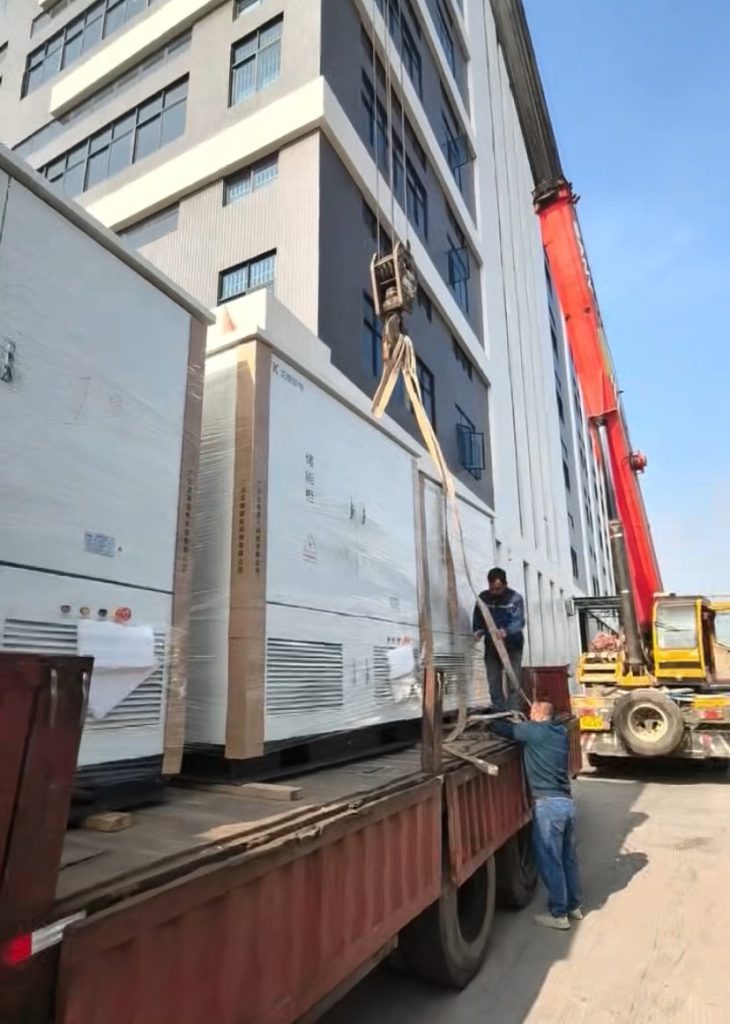
Our packaging standard is as follows: reinforced wooden crates, cushioning materials filled inside, gaps between the cabinet and the crate secured with corner protectors and foam, three layers of waterproof film wrapped around the outside, corner guards added to all four corners, and fork lift pockets left at the bottom.
Why go to such lengths? Because during sea freight, the cabinets must endure bumpy rides, humidity, salt spray, high temperatures, low temperatures, and various environmental conditions. If the packaging is not sturdy enough, the cabinets may get scratched or damaged by the time they reach the customer. Moreover, if any issues occur, filing claims with the insurance company becomes troublesome, and what ultimately gets delayed is the customer’s time.
On the day the goods were loaded into the container, we took photos and sent them to the customer. The shipping marks on the wooden crates showed a city in Thailand as the destination. The customer replied with an emoji and said, “Finally ready to go.”
Days 171 to 210: Sea Freight – Checking the Vessel Tracker Every Day
After the ship set sail, we checked the vessel tracker every day to see where it was. Not because we were worried, but because the customer would ask: “Where is the ship now?”
We felt that when the customer asked this question, they weren’t really wanting to know the ship’s exact position, but rather “how much longer do I have to wait?” So we took the initiative to provide updates: the ship had reached the South China Sea, passed through Malacca, entered the Indian Ocean, arrived at Suez…
During the more than forty days of the voyage, the ship encountered a storm in the Mediterranean Sea, causing a three‑day delay. We notified the customer immediately so they could prepare accordingly. The customer said, “Thank you for keeping me informed so promptly.”
Days 211 to 240: Customs Clearance and Delivery – Keeping an Eye on the Last Mile
After the ship arrived at the Thai port, the next steps were customs clearance and delivery. We did not handle this part directly, but we helped coordinate with the freight forwarder and kept track of the progress.
During customs clearance, the authorities randomly inspected a batch of cabinets, which caused a delay of a few days. We assisted the customer by providing additional documents and explaining certain parameters, and ultimately the goods were cleared without issue.
On the day the goods were delivered to the customer’s warehouse, the customer sent us a photo. In the photo, rows of wooden crates were neatly stacked in the warehouse. The customer said: “Received. All arrived intact.”
Days 241 to 300: Installation and Commissioning – After‑Sales Service Begins Here
Delivery of the goods was not the end, but rather the beginning of service.
The customer began installation on their end. Our after‑sales engineer, Lao Zhou, provided remote guidance, helping them configure the parameters, debug the communication, and confirm the operating status.
During installation, the customer encountered a small issue: the unit of measurement displayed on the screen was kilowatt‑hours, but they were accustomed to using megawatt‑hours. Lao Zhou adjusted the parameters remotely, and the issue was resolved in three minutes.
After installation was completed, the customer sent us a video. In the video, several energy storage cabinets were neatly arranged in the equipment room, with numbers on the screens flickering. The customer said: “They’re very quiet, even better than we expected.”
A Final Note
This is the complete journey of one order. From the very first email to the final commissioning of the last cabinet, nearly three hundred days passed.
Over those three hundred days, we did many things: communicating requirements, preparing certifications, confirming samples, scheduling production and procuring materials, manufacturing, packaging and shipping, sea freight, customs clearance and delivery, installation and commissioning. But what the customer could see were only the few emails and the cabinets they finally received.
That is why we wrote this article—to let future customers know: on the day you place your order with Longwei Xindian, over the next three hundred days, there are people who are diligently working for you. Every cabinet reaches you only after going through these three hundred days.
If you too would like to go through this journey, feel free to reach out to us. We’ll start with the very first email.