
Industry Insight
How Battery Energy Storage Supports Factories with Unstable Grid Power
For many factories, reliable electricity is essential to maintaining production. Power interruptions can stop manufacturing equipment, interrupt production lines, affect refrigeration systems, and create unexpected restart costs.
How Battery Energy Storage Supports Factories with Unstable Grid Power
For many factories, reliable electricity is essential to maintaining production.
Power interruptions can stop manufacturing equipment, interrupt production lines, affect refrigeration systems, and create unexpected restart costs.
This is one reason why commercial and industrial battery energy storage systems (C&I BESS) are becoming increasingly important for factories in Africa, Southeast Asia, the Middle East, and other markets where grid reliability can be a challenge.
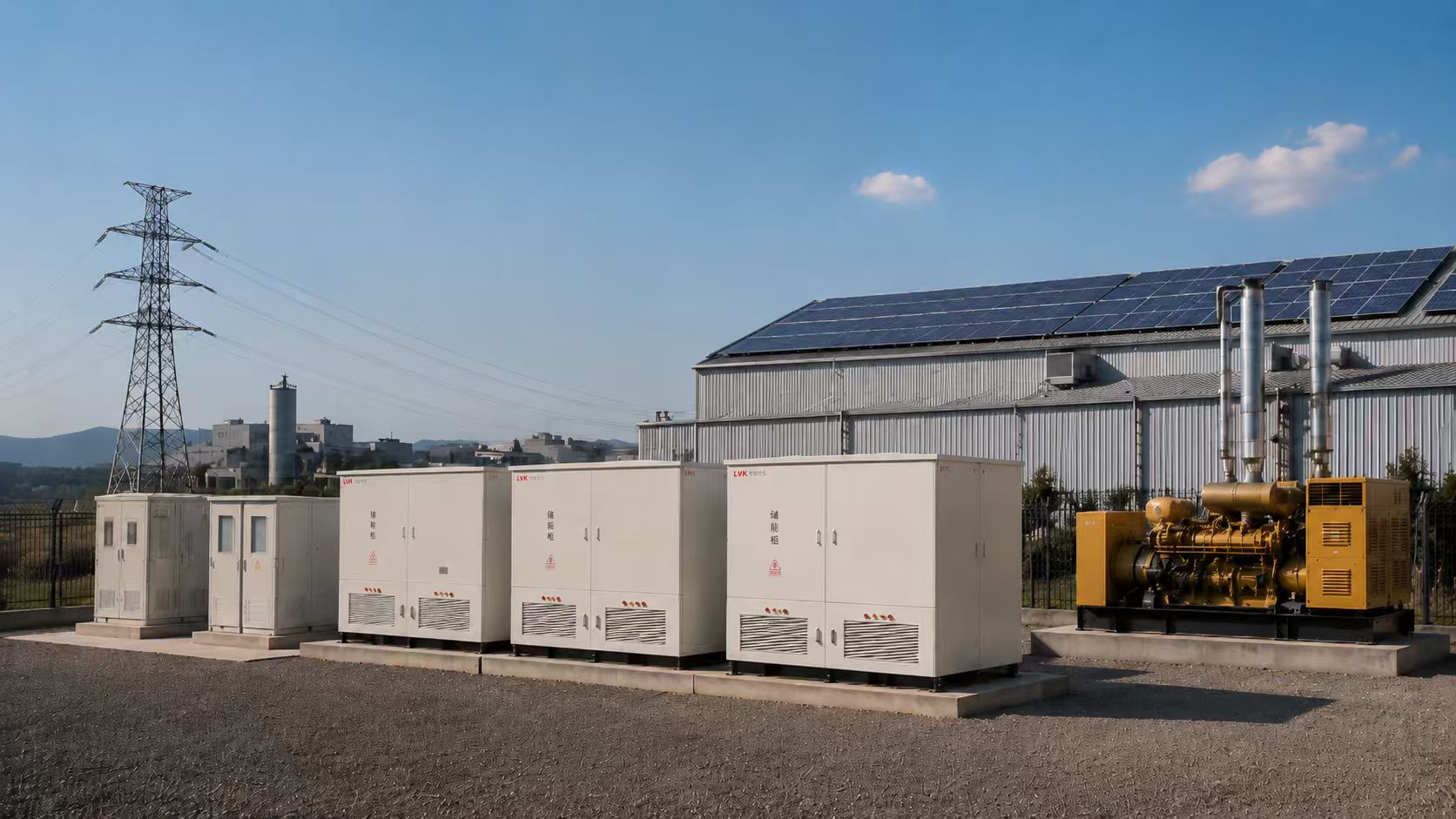
A properly designed BESS can work with solar PV, the grid, and diesel generators to create a more flexible industrial power system.
The Cost of Unstable Grid Power
Grid instability can create several operational problems.
Production Downtime
When electricity suddenly fails, production equipment may stop immediately.
Depending on the factory and manufacturing process, restarting equipment can take significant time and may result in lost production.
Equipment Protection
Voltage fluctuations, power disturbances, and sudden interruptions can create additional risks for sensitive electrical equipment.
The actual protection requirements depend on the equipment and electrical architecture of the facility.
Diesel Generator Dependence
Many factories use diesel generators as backup power.
Generators can provide important backup capacity, but they also create:
Fuel costs
Maintenance requirements
Noise
Emissions
Manual operating requirements
Battery storage can be integrated with generators to provide a more flexible hybrid power system and, depending on the project design, reduce unnecessary generator operation.
How Can BESS Improve Factory Power Reliability?
A battery energy storage system can respond rapidly to changes in power conditions.
A typical hybrid architecture may include:
Grid + Solar PV + BESS + EMS + Diesel Generator + Factory Load
The exact architecture depends on the required application and whether the BESS is designed for grid-connected operation, backup power, or microgrid operation.
When grid power is available:
Grid + Solar → Factory Load
When solar generation exceeds demand:
Solar → Factory Load + Battery
When the grid fails and the BESS is designed for backup or microgrid operation:
BESS → Designated Critical Loads
If the outage continues and additional backup is required:
BESS + Diesel Generator → Critical Loads
This creates a flexible hybrid power architecture for industrial facilities.
Battery Storage and Solar PV
Solar PV can reduce dependence on grid electricity, but solar generation changes throughout the day.
Battery storage can help address this mismatch.
During strong solar generation:
Solar → Factory Load + Battery
Later, when solar output decreases:
Battery → Factory Load
This allows energy generated during one period to support factory loads later in the day.
For industrial projects, the objective may be to increase solar self-consumption, reduce grid demand, improve energy cost management, or support backup operation.
The final system strategy should be based on the factory’s actual load and energy requirements.
Battery Storage and Diesel Generators
BESS does not necessarily need to replace diesel generators.
For many industrial projects, combining battery storage and diesel generation can provide a more practical solution.
For example:
Grid Failure → BESS Responds
If the outage continues:
BESS + Diesel Generator
The battery can provide rapid power response while the generator starts or operates according to the microgrid control strategy.
Depending on system design, this can help reduce unnecessary generator runtime and improve the use of diesel fuel.
The actual control strategy depends on the BESS PCS, EMS, generator controller, switching equipment, and microgrid architecture.
Why EMS Is Critical in Hybrid Energy Systems
A hybrid energy system requires intelligent control.
The EMS may monitor:
Grid availability
Solar generation
Factory demand
Battery state of charge
Diesel generator status
Operating schedules
System alarms
Based on these conditions, the control system can determine how different energy sources should operate.
For example, the project may prioritize solar energy when available, use the battery to manage short-term demand, and start the diesel generator when additional backup capacity is required.
This is particularly important for industrial facilities where both power reliability and operating costs matter.
What Data Is Needed to Design a Factory BESS?
Before designing a BESS for a factory with unstable grid power, EPC companies should collect project-specific information.
1. Historical Electricity Consumption
Monthly electricity consumption helps establish the facility’s general energy requirements.
2. Peak Load
Peak power demand is important for determining PCS power and system operating strategy.
3. Critical Loads
Not every factory load necessarily needs to remain powered during an outage.
Identifying critical loads can significantly affect the required battery capacity.
4. Outage Frequency
The number of outages can help determine how frequently the BESS may need to operate in backup mode.
5. Outage Duration
A short interruption and a multi-hour outage require very different system designs.
6. Solar Generation Data
Existing or planned PV capacity should be evaluated together with battery capacity and load demand.
7. Diesel Generator Capacity
If the factory already has diesel generators, their capacity and operating characteristics should be included in the hybrid system design.
8. Required Backup Duration
The required backup time is one of the most important factors in determining battery capacity.
Which Factories Can Benefit?
Battery energy storage and hybrid power systems can support:
Manufacturing factories
Agricultural processing facilities
Cold storage warehouses
Industrial parks
Mining-related facilities
Commercial buildings
EV charging sites
Remote industrial facilities
The ideal configuration depends on the customer’s load profile, grid conditions, critical loads, solar generation, generator capacity, and required backup duration.
What Should EPC Companies Consider?
Before proposing a BESS project for an industrial customer, EPC companies should answer several questions:
Is the main objective backup power, energy cost reduction, solar self-consumption, or a combination of these?
Which factory loads are critical during an outage?
How long must these loads remain operational?
Does the facility already have solar PV?
Is a diesel generator already installed?
Does the BESS need to operate as part of a microgrid?
What are the local grid and electrical requirements?
These answers determine the appropriate battery capacity, PCS power, EMS strategy, and system architecture.
Conclusion
For factories operating with unreliable grid power, battery storage can provide much more than backup electricity.
A properly designed C&I BESS can combine:
Solar Energy + Battery Storage + Grid + Diesel Backup + Intelligent EMS
to improve power reliability, increase renewable energy utilization, and support more efficient industrial operations.
However, the BESS should be designed around the actual project rather than treated as a standard backup battery.
Critical loads, outage duration, solar capacity, generator capacity, PCS power, battery capacity, and control strategy all need to be considered together.
LVK Power develops C&I BESS solutions for factories, industrial parks, EPC contractors, and system integrators across international markets.
For hybrid projects, LVK Power can support configurations combining battery storage, solar PV, grid power, diesel generation, and intelligent energy management according to project requirements.
FAQ
Can battery storage provide backup power for factories?
Yes. When the BESS is designed for backup or microgrid operation, it can supply designated critical loads during grid interruptions. The actual backup configuration depends on the PCS, switching equipment, load requirements, and system architecture.
Can BESS work with diesel generators?
Yes. Battery storage can be integrated with diesel generators as part of a hybrid energy system. The EMS and control system can coordinate the battery and generator according to project requirements.
Can solar PV be combined with battery storage for factories?
Yes. Solar PV can supply factory loads and charge the battery with available excess energy. The stored energy can then be used when solar output is lower or when the project requires battery support.
Is EMS required for peak shaving?
EMS is highly important because it controls battery charging and discharging according to load demand, grid conditions, battery state of charge, and the project's energy strategy.
How long can a BESS power a factory during an outage?
Backup duration depends on battery capacity, PCS output, factory load, critical-load requirements, and the amount of energy required during the outage.
Does every factory need a large battery for backup power?
Not necessarily. If only critical loads need to remain operational during an outage, the BESS can potentially be sized around those loads rather than the entire factory demand.