
Industry Insight
AC-Coupled vs DC-Coupled BESS: Which Is Better for C&I Solar Projects?
When designing a commercial and industrial battery energy storage system, EPC companies often need to decide whether to use an AC-coupled or DC-coupled architecture. Both approaches can integrate solar PV with battery storage, but they connect the systems differently.
AC-Coupled vs DC-Coupled BESS: Which Is Better for C&I Solar Projects?
When designing a commercial and industrial battery energy storage system, EPC companies often need to decide whether to use an AC-coupled or DC-coupled architecture.
Both approaches can integrate solar PV with battery storage, but they connect the systems differently.
The better option depends on the existing PV system, project objectives, energy management strategy, electrical architecture, expansion requirements, and overall system design.
There is no universal answer that makes AC coupling or DC coupling better for every C&I project.
What Is an AC-Coupled Energy Storage System?
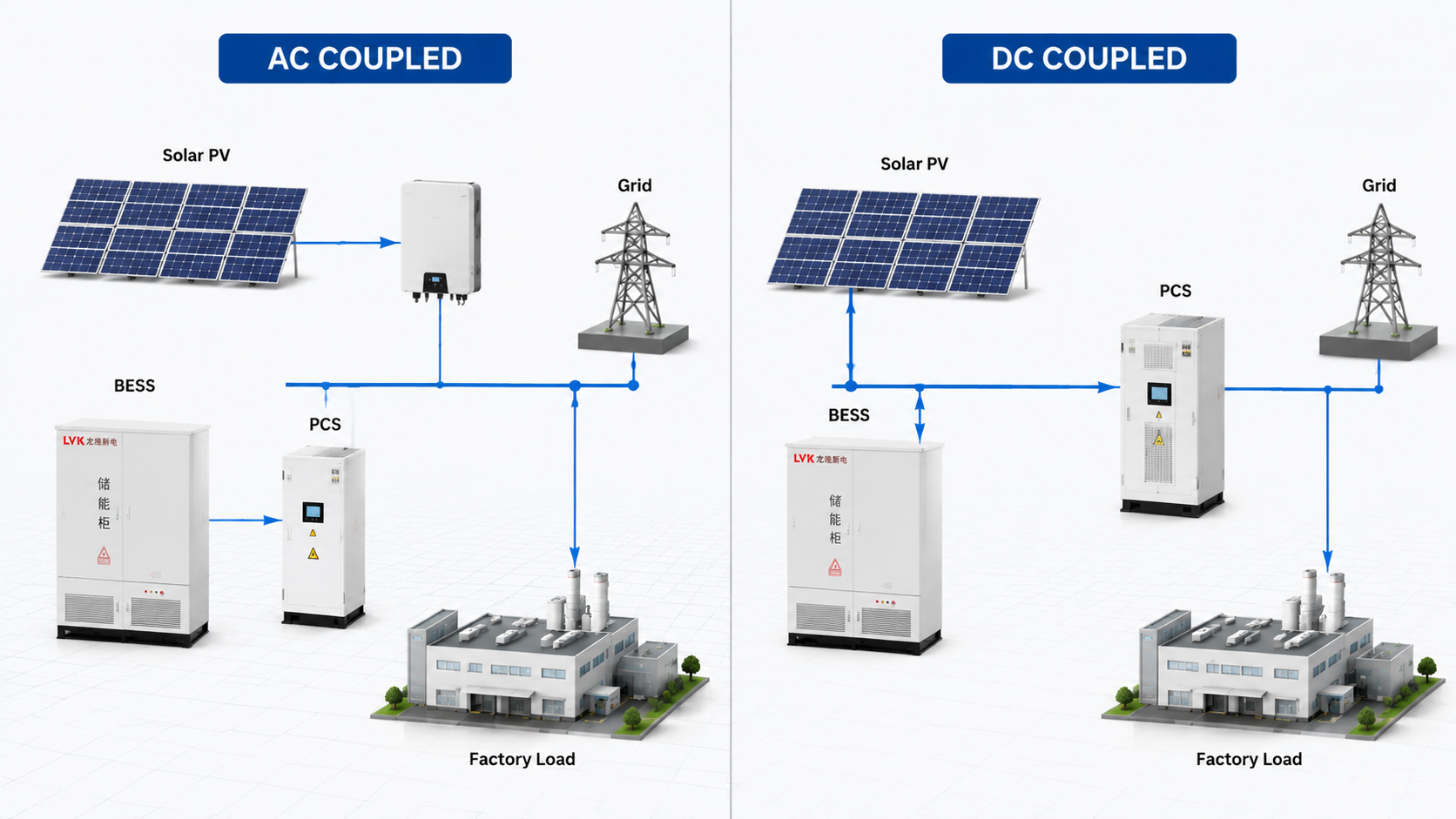
In an AC-coupled system, the solar PV system and battery storage system are connected on the AC side.
A simplified architecture is:
Solar PV → Solar Inverter → AC Bus
Battery → PCS → AC Bus
AC Bus → Factory Load / Grid
The solar inverter and battery PCS operate as separate power conversion systems.
This architecture is often attractive for retrofit projects where an existing solar PV system is already installed.
For example:
Existing Factory Solar PV + New BESS
The existing solar inverter can continue operating while the battery system is connected through the AC side.
This can reduce the need to redesign the existing PV system.
What Is a DC-Coupled Energy Storage System?
In a DC-coupled system, solar PV and battery storage are integrated on the DC side before power is converted to AC.
A simplified architecture is:
Solar PV → DC Bus → Battery
DC Bus → PCS → AC Load / Grid
Depending on the system architecture, DC-coupled systems may include DC/DC conversion, battery management, and other power conversion equipment.
The exact architecture varies according to the PV inverter, battery system, DC/DC converter, PCS configuration, and project requirements.
DC coupling can be attractive for new solar + storage projects that are designed as an integrated system from the beginning.
AC-Coupled vs DC-Coupled: Key Differences
AC-Coupled
Often suitable for existing PV retrofit projects
PV inverter and BESS PCS can operate independently
Flexible for adding storage to an existing solar system
Suitable when PV and BESS need separate control
Can simplify certain retrofit projects
DC-Coupled
Often suitable for new integrated solar + storage projects
Provides more direct DC-side integration between PV and battery
Can reduce conversion stages in certain operating conditions
Can improve the use of excess solar generation depending on system design
Suitable when the PV and BESS are engineered together
Actual system performance depends on the complete architecture, equipment efficiency, operating conditions, and energy management strategy.
When Should EPC Companies Choose AC Coupling?
AC coupling is often suitable when the customer already has an operating solar PV system and wants to add battery storage.
For example:
Existing Factory Solar PV + New Battery Storage
The existing PV inverter can remain in operation while the BESS is connected through the AC side.
Potential advantages include:
Easier retrofit
Independent PV and battery operation
Flexible system expansion
Reduced changes to existing PV equipment
Suitable for existing solar projects
This can make AC coupling attractive for factory energy storage upgrades.
When Is DC Coupling More Suitable?
DC coupling can be attractive for new solar + storage projects where the PV and BESS are designed together from the beginning.
Potential advantages include:
Integrated PV and battery architecture
Direct DC-side energy integration
Reduced conversion stages in certain operating conditions
Efficient use of excess solar generation
Integrated energy management
DC-coupled systems can be particularly useful when maximizing solar energy utilization is a major project objective.
However, the actual benefits depend on the complete electrical design and equipment configuration.
AC-Coupled vs DC-Coupled: Which Is More Efficient?
It is tempting to say that DC coupling is always more efficient because energy can avoid some conversion stages.
However, system efficiency cannot be determined from the coupling architecture alone.
EPC companies should consider the complete energy path, including:
PV inverter efficiency
PCS efficiency
DC/DC conversion
Battery efficiency
Wiring losses
Operating conditions
Battery state of charge
EMS strategy
Therefore, DC coupling can reduce conversion stages in certain operating conditions, but the actual project efficiency depends on the entire system design.
Which Architecture Is Better for C&I BESS?
There is no universal answer.
The right architecture depends on the project.
Choose AC Coupling When:
Existing solar PV is already installed
The customer wants to retrofit battery storage
Independent PV and battery operation is preferred
Flexible expansion is important
The existing PV inverter should remain in operation
Consider DC Coupling When:
Solar PV and BESS are designed together
Solar self-consumption is a major objective
Integrated DC-side energy management is required
The project is optimized around renewable energy utilization
The complete system can be engineered as one integrated architecture
What Should EPC Companies Consider Before Selecting the Architecture?
1. Existing Solar System
Is the PV system already installed?
If yes, AC coupling may simplify integration.
For a new solar + storage project, both AC and DC architectures should be evaluated during system design.
2. Project Load Profile
Understand:
Daytime load
Evening load
Peak demand
Solar generation
Critical loads
Seasonal changes
The load profile can affect the value of different system architectures.
3. Energy Storage Objective
Determine what the BESS is expected to achieve.
Is the main objective:
Peak shaving?
Solar self-consumption?
Energy shifting?
Backup power?
Microgrid operation?
EV charging support?
Different objectives can lead to different system designs.
4. Existing Electrical Infrastructure
For retrofit projects, EPC companies should evaluate the existing:
PV inverter
AC distribution system
Transformer
Switchgear
Protection system
Communication system
The architecture should fit the existing electrical infrastructure rather than requiring unnecessary changes.
5. Future Expansion
If the customer plans to increase solar or battery capacity later, the architecture should support the expected expansion strategy.
The EPC company should consider future.
PV capacity
Battery capacity
PCS capacity
Load growth
Energy management requirements
A Practical Decision Guide for EPC Companies
A simple project-level decision process can be:
Existing PV system?
→ Yes → Evaluate AC coupling first
→ No → Compare AC and DC coupling during system design
Then consider:
Main objective = solar self-consumption?
→ Evaluate DC-coupled architecture
Main objective = retrofit + peak shaving?
→ Evaluate AC-coupled architecture
Main objective = hybrid microgrid?
→ Compare the complete system architecture, PCS capabilities, EMS strategy, switching requirements, and critical-load configuration.
This is only a starting point. Final architecture should be selected based on the complete electrical design and project requirements.
Conclusion
Both AC-coupled and DC-coupled energy storage systems can be effective for C&I solar projects.
The right choice depends on:
Solar System + Load Profile + Project Objective + Existing Infrastructure + Future Expansion
AC coupling can be attractive for retrofitting BESS into existing solar projects, while DC coupling can be advantageous for new integrated solar + storage systems under suitable operating conditions.
For EPC companies, the most important consideration is not choosing the architecture that sounds more advanced.
It is selecting the architecture that best matches the customer’s actual energy requirements, existing infrastructure, and long-term project objectives.
LVK Power supports EPC contractors, distributors, and system integrators with customized C&I BESS solutions, solar + storage systems, and energy management solutions for international projects.
If you are evaluating AC- or DC-coupled storage for a commercial or industrial solar project, contact LVK Power with your PV capacity, load profile, battery requirement, and project objectives for a project-specific configuration.
FAQ
What is the main difference between AC-coupled and DC-coupled BESS?
AC-coupled systems connect solar PV and battery storage through the AC side, while DC-coupled systems integrate solar PV and battery storage on the DC side before the main AC conversion stage.
Is AC coupling better for existing solar projects?
AC coupling is often suitable for retrofitting battery storage to an existing solar PV system because the existing PV inverter can remain independent.
Is DC coupling more efficient?
DC coupling can reduce conversion stages in certain operating conditions, but actual system efficiency depends on the complete architecture, equipment, operating conditions, and energy management strategy.
Which is better for a factory energy storage project?
It depends on whether the project is a new solar + storage installation or a retrofit, as well as the factory load profile, energy objectives, existing electrical infrastructure, and future expansion plans.
Can AC or DC coupling be used with peak shaving?
Yes. Both architectures can support peak-shaving applications when properly designed. The appropriate configuration depends on the PV system, battery capacity, PCS power, load profile, and EMS strategy.